October 10th is marked the world over as Mental Health Awareness Day. I got a request from a prominent organisation that supports neurodivergent children, teens and young adults, this October, to share my thoughts on mental health, based on my lived experience as an autistic AAC user. This interesting collaboration got me thinking about how my senses perceive the world atypically, and how this experience has a significant impact on my mental health and wellbeing.

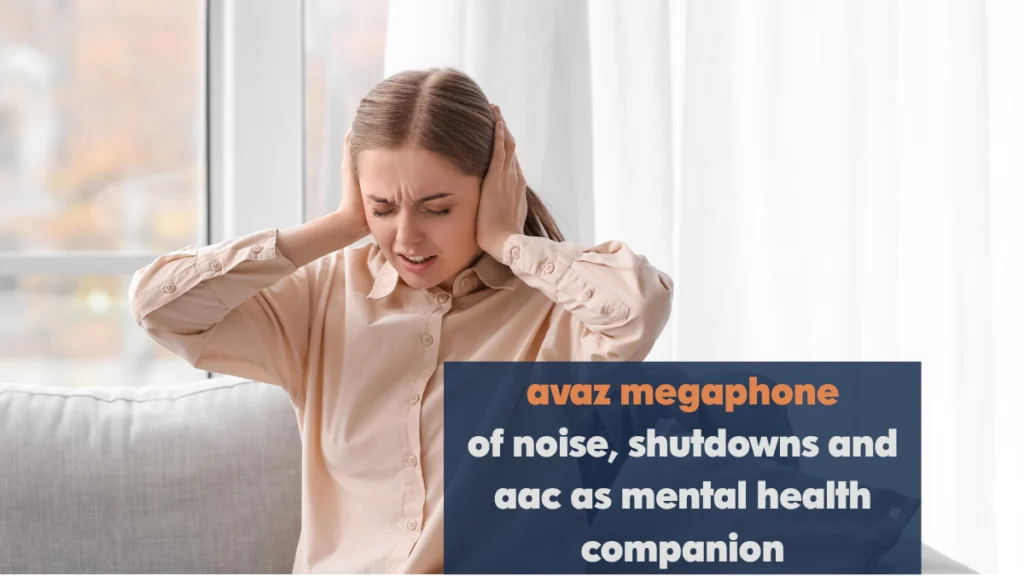
I have extremely sensitive senses that perceive the world around a lot more intensely than that of most other people. What this means is that commonplace experiences like whooshing of the pressure cooker, rattling of the blender, clanging of utensils, noises from loud TV shows, the incessant barking of an unruly pet, euphoric drums and off key music from very public celebrations, the ambulance siren and more are too loud and too intense for my comfort. Yet, as you would agree, these noises are such an integral part of our everyday lives that most people don’t even give it a passing thought. My senses perceive these very same sounds so intensely that it begins to cause anxiety- the feeling of my heart racing, coupled with excessive sweat and a vague feeling of things spiralling out of control. What helps me is moving to a quieter space, wearing my noise cancelling headphones, and more importantly, having access to AAC, and pre-typed and saved messages asking for accommodations, that is merely two touches away.
Is dealing with anxiety induced by sensory inputs that simple, you may wonder. If yes, why do meltdowns and shutdowns happen?
The relationship between uncomfortable sensory stimuli and seeking accommodation and help is not exactly linear for many of us autistics with complex communication needs. Many of us do not recognise the early signs of overwhelm , and by the time the realisation dawns, things begin to go haywire . And for yet others among us, including yours truly, we choose to ignore the subtle signs and carry on until things go south. This, for me, results in intense shutdowns- involuntary nervous system response to sensory overload that causes me to ‘freeze’, making it nearly impossible for me to move or respond, while being fully aware of everything that is happening around. Shutdowns may be perceived as ‘socially acceptable’ as compared to a meltdown , since there are no loud outbursts; but it’s way more tiring, and it takes longer to recover. Frequent shutdowns lead to burnout , and burnouts make the process of recovery more arduous, making one want to figure out ways to identify the advent of an overwhelm early enough to take a pause, and prevent the shutdown.
This is where therapeutic practices like Cognitive Behaviour Therapy have been of help to me, by helping me identify sensory triggers, and ways to identify certain bodily signals that indicate I need to pause and take a step back. But, here’s the thing about these therapies- they are ‘talk therapies’; therapies that entail conversations around certain happenings and themes, with the therapist, to identify possible thought patterns and cognitive distortions that contribute to not being able to take a step back on time to acknowledge bodily symptoms of sensory fatigue and take a break before things go out of hand. And, this is where being able to express by typing on Avaz has helped me have these conversations, understand my own thoughts and come up with strategies to meet my sensory motor differences, and the resulting challenges midway. As with everything else, having access to a reliable mode of communication has enabled access to appropriate services.
In the current scenario, there is precious little that is known about the mental health challenges of autistics with high support needs, quite obviously because of an inability to communicate. Mental health, however, is closely linked to physical health and the quality of life. Here’s hoping that utilising AI in AAC would open up ways to help this vulnerable group communicate both mental and physical health needs, thereby enabling access to appropriate healthcare services and improving the quality of life.
Avaz Megaphone is a platform for neurodivergent individuals to express themselves through the written word. We accept opinion pieces, short stories and poetry. Authors of accepted works will receive an honorarium. To make a submission please email us on: collaborate@avazapp.com
WRITTEN BY
Aditi Sowmyanarayan
Student & Writer
Aditi Sowmyanarayan is a nineteen year old who uses Avaz, a text to speech app, to communicate. She goes to Ishanya India Foundation, a special school in Bengaluru. Aditi is an avid blogger and an aspiring writer. She blogs on www.smallstepbigthought.blogspot.com
She can be reached on Instagram at writeaditi and on her Facebook page : small step big thought